Practise job interviews with an AI coach that guards your privacy
Interview Coach prepares you for one specific vacancy: a briefing, a practice interview in which an AI interviewer follows up on your answers, and an honest review with scores, sources and a practice plan.
This page shows a complete practice round by a fictional candidate. You can also try the app yourself; choose how to start:
Try it yourself
A username and password, no email. You upload a vacancy and your CV and do a 15 to 45 minute interview.
The local model is online right now.
What to expect ↓Look around first
The three steps of a round, with screenshots, followed by the real result of this round.
You don't fill anything in on this page itself; it is only for viewing.
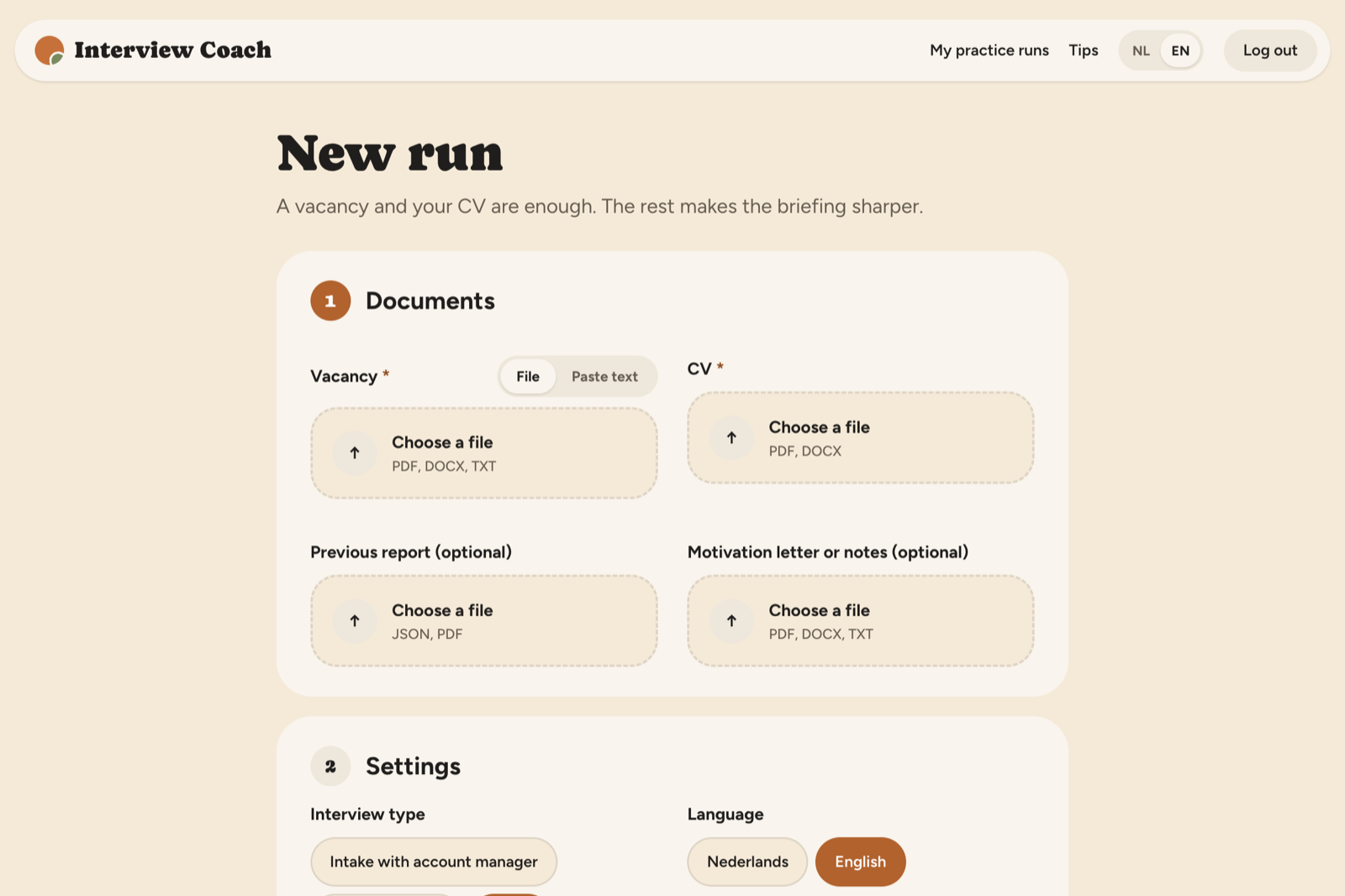
- PrepareUpload the vacancy and your CV. The app finds evidence for each requirement and writes a briefing.
 Screenshot
You start with the vacancy and your CV. Preparation takes about 3 minutes. - PractiseA 15 to 45 minute interview, typed or spoken, with follow-up questions on your answers.
 Screenshot
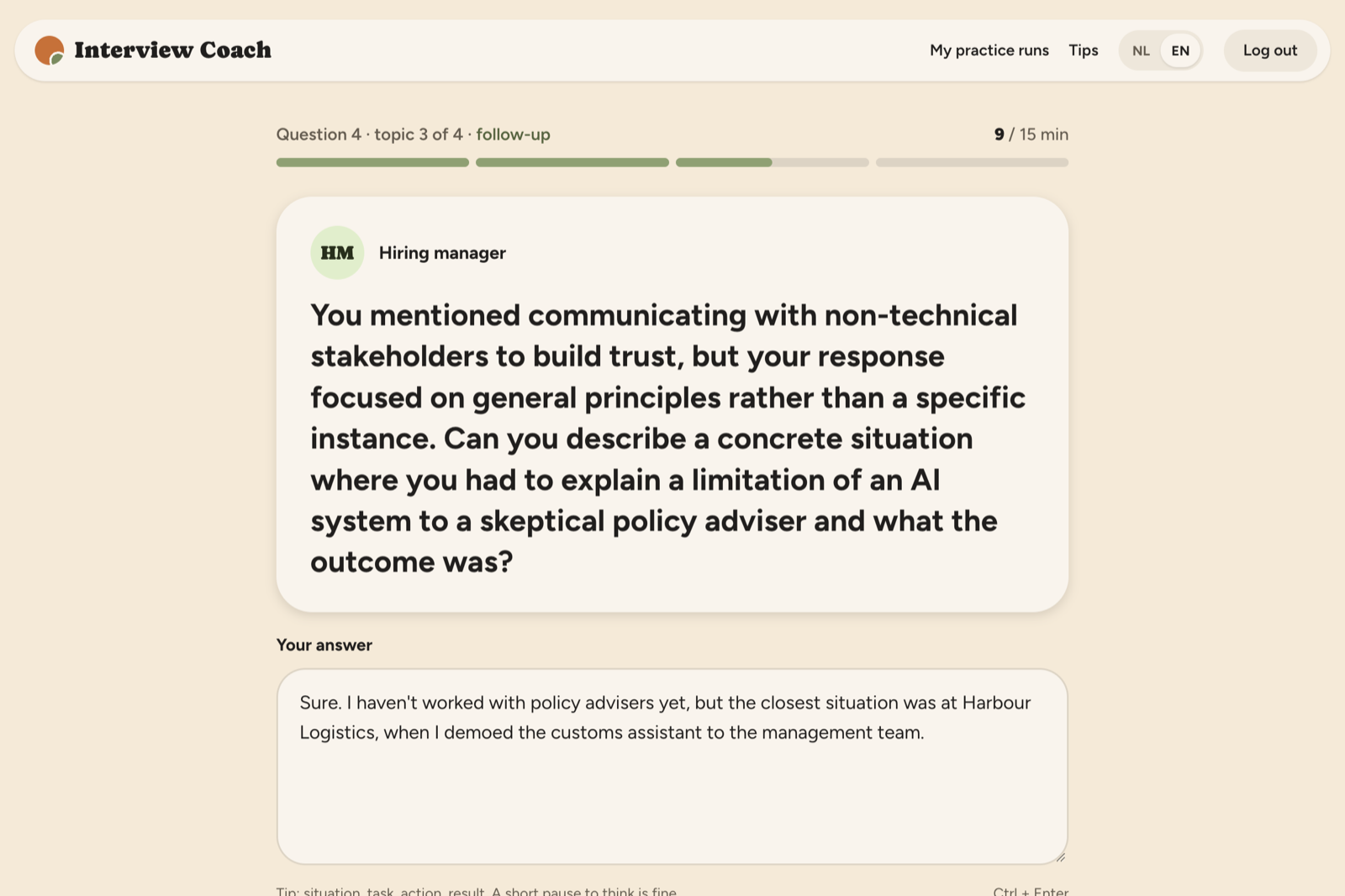
A follow-up from this round: the interviewer picks up on what the candidate just said. - ReviewScores per answer (STAR, specificity, results), requirement coverage and feedback that cites its sources.The result of this round is below ↓
Under the hood
Five models, each with its own job, orchestrated in code. Raw text only goes to the local model; external services only get pseudonymised text.
| Model | Runs | Job | Why this model |
|---|---|---|---|
| Qwen 3.6 35B-A3B | local | Pseudonymises raw text, pulls the requirements out of the vacancy and writes every interview question, in the interviewer's role. | Sees raw text, so it must stay on own hardware; open source, free and fast enough for every question. |
| bge-m3 | local | Finds the evidence in the CV for each requirement (retrieval). | Multilingual (Dutch and English), open source, runs locally. |
| Jev 1.13.0 (TypeSafe) | external | Judges every answer (STAR, specificity, requirement coverage, quality, next move) and checks every generated question before it is shown. | Typed judgments with a probability; fast and cheap (≈€0.002 per round). |
| Claude Sonnet 5.5 | external | Writes the interview plan (scenario and interviewers), the briefing and the feedback with sources, and gives a second opinion when Jev is unsure. | Careful, longer texts; about 99% of the cost. |
| Claude Haiku 4.5 | external | Writes the question when the local model's attempts fail the checks twice. | Fast, cheap fallback. |
Design choices
- Privacy enforced in code: external services refuse unfiltered text, and the prompts treat documents as data, not as instructions (against prompt injection).
- The cheapest model that does the job well: measured at ≈€0.20 per 15-minute round.
- Checks instead of blind trust: every question is checked, uncertain judgments get a second opinion, and feedback cites the CV or the answer.
- Measured, not assumed: every model call is logged (role, model, which model answered, tokens, cost, latency), with budget caps per round and per day.
Deliberately a fixed, code-driven flow rather than autonomous agents: predictable, testable, and raw text stays local. Thresholds are starting values; an evaluation set to tune them is planned.
This is a real run with a fictional candidate (Sanne Visser) and a fictional vacancy. Everything below is unedited model output.
Built with FastAPI, htmx, SQLite, Ollama (Qwen), Claude and TypeSafe Jev; runs in Docker behind nginx. · Source code on GitHub
Briefing
what the candidate got before the interview
Likely questions
- Can you walk us through the RAG assistant you built at Harbour Logistics — how did you design it and what LLM tooling did you use?
- How do you measure answer quality and reduce hallucinations in an LLM application, and how did your guardrail approach at Harbour Logistics work in practice?
- You have strong Python and pipeline experience, but the role centers on production LLM applications — how would you translate your existing skills into designing agents and RAG systems for the city's use cases?
- This role requires close collaboration with a platform team to take applications to production — can you describe how you worked with the platform team on the Kubernetes deployment?
- How would you explain a technical decision — like why an answer was refused due to no source found — to a non-technical policy stakeholder?
- Tell us about your experience with GDPR and personal data; how would that translate to working with resident data in a public sector context?
- Why are you interested in working for a city government rather than a private company, and how do you see the public sector's needs differing?
- Do you have experience with self-hosted or open-source models, such as Ollama, and how would you decide between open-source and hosted LLMs for a public sector project?
Your strongest evidence
Honest gaps
There's no explicit mention of building agents, but the RAG assistant project (cv:role1:b1-b4) is directly relevant. Bridge by describing that project in depth and note willingness to extend into agent-based architectures, being honest that agents specifically are new territory.
No CV evidence of ongoing operational ownership beyond deployment, though Docker/GitHub Actions/Kubernetes deployment (cv:role1:b4) shows some production experience. Be honest that day-to-day running post-deployment wasn't a core part of the role, but express eagerness to take more ownership of run/maintain responsibilities, referencing collaboration with the platform team on deployment.
Not a distinct responsibility in the CV, but strongly supported by wens_1 evidence (evaluation set, guardrails). Reuse the role1:b2/b3 story directly as the answer — this is likely the strongest bridge in the whole interview.
No explicit example of translating policy/operations questions into technical solutions, though the profile claims ability to explain technical choices. Prepare a concrete story where they explained the RAG assistant's guardrails or limitations to non-technical planners, and be upfront that direct policy-translation experience is limited.
Only partial evidence via GDPR work with a privacy officer, not explicit public-sector experience. Be honest that this is client-consultancy work, not government, but highlight the complexity of multi-stakeholder client work at DataWorks and express strong motivation for public sector mission.
A strong interview. Keep this level.
Statistics
STAR
STAR: S 60%, T 60%, A 60%, R 60%. Concrete examples in 60% of answers; results quantified in 40%. Weakest element: S.
Quality
Answer quality (0 = does not answer, 3 = concrete, structured, with result): level 0: 0, level 1: 1, level 2: 1, level 3: 3.
Requirement coverage
| Requirement | In documents | In interview |
|---|---|---|
| A completed degree at bachelor level or higher in computer science, AI, data science or similar. required — you have this, but did not bring it up | ✓ strong | ✗ none |
| At least 3 years of experience with Python in production environments. required — you have this, but did not bring it up | ✓ strong | ✗ none |
| Demonstrable experience with applications based on language models (for example RAG). required | ~ partial | ✓ strong |
| Experience with CI/CD, containers (Docker) and version control (Git). required | ✓ strong | ✓ strong |
| Good written and spoken English. required | ✓ strong | ✓ strong |
| Experience evaluating LLM output and building guardrails. nice to have | ✓ strong | ✓ strong |
| Knowledge of privacy law (GDPR) and working with personal data. nice to have — you have this, but did not bring it up | ✓ strong | ✗ none |
| Experience with open-source or self-hosted language models. nice to have — you have this, but did not bring it up | ✓ strong | ✗ none |
| Experience in the public sector or with complex stakeholders. nice to have — you have this, but did not bring it up | ~ partial | ✗ none |
Practice plan
- Rework your answer about building trust with non-technical stakeholders into one concrete STAR story instead of general principles. Pick a specific moment (like the demo you gave in turn:d86f87bce07740b09c1c6588234a8e26) and lead with that from the start.Your initial answer on this topic scored highest quality but stayed abstract, and the interviewer had to explicitly ask for a concrete example before you delivered a strong story. Leading with specifics avoids that follow-up entirely. answeranswerTell it as STAR
- Explicitly mention your degree and your years of Python production experience somewhere in your answers, even briefly, since they weren't brought up at all.Both requirements are flagged as weak points with high severity (0.7) because they were never addressed, even though they're likely on your CV and relevant to eligibility for the role. answerAddress a gap honestly, then bridge
- When telling stories, push harder on quantified results (numbers, percentages, time saved) since only 40% of your answers included quantification.Your CI/CD story (turn:f69fd4b984524c3d969483c5a2f2dc5a) and others have strong structure but often stop short of a measurable outcome, which would make the impact more convincing. answerTell it as STAR
- Keep using a brief pause before answering tricky or unexpected questions, especially follow-ups that ask you to get more specific.The follow-up question about policy advisers shows interviewers will push for concrete detail; a short pause helps you retrieve a real example instead of defaulting to general statements. answerPause before you answer
- Continue closing interviews with sharp, role-relevant questions like the ones you asked about evaluation ownership and go-live criteria.Your closing question scored a perfect 2.0 and showed genuine insight into production quality risks, which is a strong habit to keep reinforcing. answerClose with a question of your own
Focus for next time
- Experience for 'A completed degree at bachelor level or higher in computer…' was not brought up weak
- Experience for 'At least 3 years of experience with Python in production…' was not brought up weak
Upload the report PDF with your next run to practise these again.
Answers
1 Intake account manager · Open the interview and understand motivation for the role and organisationWhat draws you to this AI Engineer role at the City of Riverton, and how do you see yourself contributing to public-sector applications? 2.8 / 3
What draws me most is that the AI directly helps residents. At Harbour Logistics I built an assistant for planners, and the best part wasn't the technology. It was seeing people do their work faster and with more confidence. At a city, that impact is even more direct: if a staff member can help a resident quickly and correctly, the resident feels it right away. I also really like that reliability, privacy and explainability come first here, because that's already how I work. Every answer from our assistant has to cite its source, and no release goes live without passing our evaluation set. I'd bring exactly that discipline. My public-sector experience is limited to an internship at a water authority, so I'd lean on policy advisers for the context. The part where you make AI measurable and trustworthy, that I can bring from day one.
quality: 2.8 · 82%✓ S✓ T✓ A✓ R✓ specific✗ quantifiedCV: consistent · Claude✗ overclaim · Claudehedging: 0.2 · 73%✗ resp_4 · Claude
Strong
- You clearly connect your Harbour Logistics work to resident impact: 'it was seeing people do their work faster and with more confidence' your answerCV role1 b1
- Good honesty about the limits of your public-sector experience, showing self-awareness your answer
Add
- You didn't mention your GDPR/privacy work with a privacy officer at DataWorks, which is directly relevant to a public-sector employer's privacy concerns CV role2 b3
- Your meetup organising on open-source AI could show community engagement and communication skills relevant to explaining choices to non-technical stakeholders CV p8
Explore
- Do you have an example, even from the water authority internship, where you had to translate a policy or operational question into a technical solution for non-technical stakeholders? CV role3 b1
- Can you describe a time you explained a technical choice (like a guardrail or model limitation) to someone without a technical background? your answer
Better outline
- Open with motivation: AI that helps residents directly, echoing the planner assistant impact you saw at Harbour Logistics your answerCV role1 b1
- Add your GDPR/privacy officer collaboration at DataWorks as evidence you already work within data protection constraints relevant to government work CV role2 b3
- Acknowledge your public-sector experience is limited to your water authority internship, and that you'd rely on policy advisers for context your answerCV role3 b1
- Close by connecting your ability to explain technical choices clearly, as shown by organising your open-source AI meetup, to translating between technical and non-technical colleagues CV p2CV p8
2 Technical lead · Explore hands-on experience building and productionising LLM-based applicationsYou mention taking applications to production with Docker and GitHub Actions on Kubernetes. Can you walk me through a specific instance where you handled versioning or CI/CD for an LLM-based application? 3.0 / 3
Sure. The clearest example is how we release changes to the customs assistant at Harbour Logistics. Early on, a change to the prompt or the retrieval setup could quietly make answers worse, and we'd only find out when a planner complained. I wanted every change to be checked before it reached users. So I set up a GitHub Actions pipeline that builds the Docker image and then runs our evaluation set of 200 verified questions against it. If the share of wrong answers goes up, the release is blocked. Only when the set passes does the image get deployed to the Kubernetes cluster. To be honest, my Kubernetes knowledge is fairly basic; the platform team runs the cluster, and I work with them on the deployment side. The result: no release goes live without passing the set, and that's a big part of how we brought wrong answers down from 18% to 6%.
quality: 3.0 · 100%✓ S✓ T✓ A✓ R✓ specific✓ quantifiedCV: consistent · 96%✗ overclaimhedging: 0.2 · 75%✗ eis_1✓ eis_3✓ eis_4✓ eis_5? resp_1 · uncertain✓ resp_2✗ wens_2
Strong
- You gave a concrete, specific example: a GitHub Actions pipeline that builds the Docker image and gates deployment on an evaluation set of 200 questions before it reaches the Kubernetes cluster. your answer
- Nice honesty about acknowledging your Kubernetes knowledge is basic and that you collaborate with the platform team rather than overclaiming. your answer
Add
- You didn't mention the guardrails you added (citations required, refuse when no source found) as part of the quality checks tied to this release process. CV role1 b3
- You didn't connect this to the concrete impact on planners, like the drop in average search time from 12 to 3 minutes. CV p4
Explore
- Do you have an example of how you decided what threshold or rollback strategy to use when the wrong-answer rate went up during a release? your answer
- Do you have an example of versioning specific components separately, like the prompt versus the retrieval index, so you could tell which change caused a regression? your answer
Better outline
- Set the problem: unchecked changes to prompts or retrieval could silently degrade answers for the customs assistant at Harbour Logistics. your answer
- Describe the pipeline: GitHub Actions builds the Docker image, then runs the 200-question evaluation set before deployment to Kubernetes. your answerCV role1 b2CV role1 b4
- Mention the guardrails (citations required, refuse when no source found) as another layer of quality control in the release process. CV role1 b3
- Be clear about ownership: you work with the platform team on Kubernetes since your knowledge there is more basic. your answerCV role1 b4
- Close with impact: wrong answers dropped from 18% to 6%, and search time per question fell from 12 to 3 minutes. your answerCV p4
3 Hiring manager · Probe quality measurement, guardrails against hallucinations, and translating needs from non-technical stakeholdersTell me about a time you had to prove to non-technical stakeholders that an AI system's answers could be trusted, and how you approached measuring or improving that trust. 1.0 / 3
I think trust mostly comes from good communication. I always try to explain things clearly and involve stakeholders early, so they understand what the system does and what it doesn't do. I also try to be transparent about the limitations, because people trust you more when you're honest with them. And I make sure to keep them updated along the way, so there are no surprises at the end. In general, I've found that if you take people seriously and listen to their concerns, they're much more open to new technology.
quality: 1.0 · 99%✗ S✗ T · Claude✗ A · Claude✗ R✗ specific✗ quantifiedCV: not_in_cv · Claude✗ overclaim? hedging: 1.1 · 49%✗ eis_2✗ resp_3✗ resp_4 · Claude✗ wens_1✗ wens_3✗ wens_4
Strong
- You emphasized being transparent about limitations and involving stakeholders early, which is a good foundation for building trust your answer
Add
- You didn't mention the evaluation set of 200 questions you built to measure answer quality and track improvement over iterations CV role1 b2
- You didn't mention the concrete guardrails you added—requiring citations and refusing to answer when no source is found—which directly address hallucination risk CV role1 b3
- You didn't mention your work with planners at Harbour Logistics, where the RAG assistant reduced search time from 12 to 3 minutes, which would be a strong concrete example for non-technical stakeholders CV role1 b1CV p4
Explore
- Do you have an example of how you specifically measured or quantified trust or accuracy for non-technical stakeholders, beyond general communication practices? your answer
- Did you present the evaluation results (e.g., the drop from 18% to 6% wrong answers) directly to non-technical stakeholders like planners or managers? CV role1 b2
Better outline
- Start with a concrete case: built a RAG assistant for planners answering customs questions, used by many stakeholders CV role1 b1
- Explain how you measured quality with an evaluation set of 200 verified questions, showing wrong answers dropped from 18% to 6% over three iterations CV role1 b2
- Describe the guardrails you introduced—mandatory citations and refusal when no source is found—to prevent hallucinations CV role1 b3
- Connect this to trust-building with stakeholders: showing measurable improvement and clear limitations helped planners rely on the system, cutting search time from 12 to 3 minutes CV role1 b1CV p4your answer
4 Hiring manager · Probe quality measurement, guardrails against hallucinations, and translating needs from non-technical stakeholdersYou mentioned communicating with non-technical stakeholders to build trust, but your response focused on general principles rather than a specific instance. Can you describe a concrete situation where you had to explain a limitation of an AI system to a skeptical policy adviser and what the outcome was? 2.9 / 3
Sure. I haven't worked with policy advisers yet, but the closest situation was at Harbour Logistics, when I demoed the customs assistant to the management team. One of them was quite skeptical. During the demo the assistant answered one question with "I don't know," and he asked why we'd roll out something that can't answer everything. I explained in plain words that this was deliberate. The assistant only answers when it can find the rule in our documents, and it always shows the source. If it can't find one, it says so, because a confident wrong answer on customs rules costs far more than a planner spending a few minutes checking. I backed that up with our evaluation results: wrong answers had come down from 18% to 6%, largely because of that refusal behaviour. After that he was on board, and the "I don't know" behaviour stayed in as a feature.
quality: 2.9 · 88%✓ S✓ T✓ A✓ R✓ specific✓ quantifiedCV: consistent · 86%✗ overclaimhedging: 0.1 · 80%✗ eis_2✓ resp_3✓ resp_4✓ wens_1✗ wens_3✗ wens_4 · Claude
Strong
- Good use of a concrete example instead of general principles: the skeptical manager, the 'I don't know' moment, and the outcome that it stayed as a feature. your answer
- You backed up your explanation with a clear metric (wrong answers down from 18% to 6%), which is convincing evidence for a skeptical audience. your answerCV role1 b2
Add
- You didn't mention the citation requirement guardrail explicitly, which is part of what convinced the manager the system was trustworthy. CV role1 b3
- You didn't mention your experience working with a privacy officer under GDPR, which is another example of translating technical/compliance constraints for a non-technical stakeholder. CV role2 b3
Explore
- Do you have an example where you explained an AI limitation specifically to someone in a policy or government role, rather than a management team, since the question asked about a policy adviser? your answer
- Was there any resistance or follow-up questions from the manager after you showed the evaluation numbers, and how did you handle pushback in the moment? your answer
Better outline
- Set the scene: skeptical manager during the customs assistant demo questioned why it said 'I don't know'. your answer
- Explain the guardrail design: answers only given with a source citation, refusal when no rule is found. CV role1 b3
- Give the reasoning: a wrong customs answer costs more than a planner double-checking. your answer
- Support with data: error rate dropped from 18% to 6% over iterations, largely due to refusal behavior. CV role1 b2your answer
- Outcome: manager was convinced, and the refusal behavior stayed as a permanent feature. your answer
5 Intake account manager · Close the interview and invite candidate questionsThat covers what I wanted to ask — what questions do you have for us about the role or the team? 2.0 / 3 · Claude
Thanks, I have two. First: how do you decide when an AI application is good enough to put in front of residents? I'm curious whether you already have fixed criteria for that, or whether it's weighed per application. And second: who in the team owns the evaluation of model output once something is live? In my experience, that's the moment quality can quietly slip if nobody is clearly responsible for it.
quality: 2.0 · Claude✗ S · Claude✗ T✗ A · Claude✗ R✗ specific✗ quantifiedCV: consistent · 79%✗ overclaimhedging: 0.1 · 90%
Add
- You could have grounded your second question in your own experience of setting up an evaluation set and tracking wrong-answer rates over iterations, which would show this isn't just a theoretical concern for you. CV role1 b2
Explore
- Do you have a concrete example of a time when evaluation ownership was unclear on one of your projects and quality started to slip, which you could reference if asked to elaborate on your second question? your answer
Better outline
- Ask how they decide when an AI application is ready for residents — fixed criteria or case-by-case. your answer
- Ask who owns ongoing evaluation of model output once live, noting that in your experience this is where quality can slip without clear ownership. your answer
- Tie it back to your guardrails work (citations required, refuse when no source found) as an example of building in accountability from the start. CV role1 b3
Try it yourself
Want to try it with a real vacancy and your own CV? Here is what to expect:
- You create an account with a username and a password; no email address needed.
- You upload a vacancy and your CV; after about 3 minutes of preparation comes a 15 to 45 minute interview.
- Names and contact details go through the local model first; rounds are deleted after 30 days.